
There is a moment in every chatbot project that separates the two kinds of software in this market.
It happens about three weeks in. The thing works. Someone on the team has built a genuinely clever conversation on a canvas, dragged the boxes into place, tested it, shown it around, and got the nods. Everyone agrees it is good.
Then somebody asks when customers will be using it, and the room goes quiet for a second longer than it should.
The pause after the nod
That pause is the whole subject of this article. Not because one product is good and the other is bad, but because some tools are built to get you to the nod, and others are built to get you past it.
Credit where it is due, because Voiceflow has earned some
Let us start honestly, since a comparison that trashes the competitor is worth nothing to you.
Voiceflow is well liked by the people who use it. It holds 4.6 out of 5 on G2 across more than a hundred reviews, which is a strong score in a category full of mediocre products. That rating is not marketing. It is customers.
What they like is the canvas. Voiceflow gives you real, granular control over how a conversation branches, and if you enjoy designing conversations, it is a pleasure to work in. Reviewers describe the basics as easy to pick up. It came out of the voice application world originally, and that heritage shows in how carefully it lets you shape a dialogue turn by turn.
If you are an agency building custom agents for clients, or a builder who wants to control every detail yourself, Voiceflow is a legitimately good choice and you should look at it properly. Their own site leads with exactly that audience, offering multi-client workspaces, white labeling, and client handoff tools.
So the question is not whether Voiceflow works. It is whether the way it is sold and shaped matches the way your business needs to buy.
The pricing page tells you who the product is for
Here is the most interesting thing I found while researching this, and you can check it yourself in thirty seconds.
Go to Voiceflow's pricing page. There are no prices on it.
What you get instead is two audience descriptions, one for agencies and partners, one for businesses, and buttons that say Book a demo and Request pricing. No plan names, no seat counts, no credit allowances, no limits. Their business tier is a conversation, not a number.
Third-party pricing trackers still report figures from earlier public plans, commonly citing something around $60 a month for a Pro tier and around $150 a month for a Business tier, with roughly $50 a month for each additional editor and credit bundles scaling well past a thousand dollars a month at the top end. Treat those as directional only. They are not from Voiceflow, and the company itself no longer publishes them, which is precisely the point worth noticing.
What unpublished pricing signals
When a company stops publishing prices, it is usually telling you something true about who it wants to talk to. A buyer who needs to compare three options on a Wednesday afternoon and put a number in a budget is now in a discovery call instead.
Two words that change the maths: editors and credits
The reported model is worth understanding even in outline, because the shape of it matters more than the exact figures.
Editors
You pay per person who can build. That is a completely normal way to sell a design tool, and if two people build your agent it is fine. But it quietly makes collaboration a line item. The marketing lead who wants to fix her own product wording, the support manager who knows exactly what customers ask and could correct an answer in ninety seconds, the person covering while someone is on leave. Every one of them is a seat decision, so in practice they do not get access, and instead they send requests to the one or two people who do. That bottleneck is not a software limitation. It is a pricing structure turning into an org chart.
Credits
Usage is metered, and reviewers are consistent about the problem with it. The complaint is not that Voiceflow is expensive. It is that the cost is hard to predict. One reviewer described the credit system as confusing when trying to calculate or forecast usage. Reviewers also report that credits cannot simply be topped up, and that when they run out, the agent stops.
The failure mode of metered agents
Sit with that last part for a second. The failure mode of a metered agent is silence, and silence arrives exactly when things are going well. Your best month of traffic, a campaign that overperforms, a product launch, and the assistant your customers now rely on goes quiet. That is not a billing inconvenience. It is a customer experience event.
We have written before about why usage-based chatbot pricing punishes success, and metered credits are a version of the same trap wearing different clothing.
There is one more detail that speaks directly to the question in the title. Reviewers point out that Voiceflow's own documentation describes the free plan as not suitable for production use, and that its credit grant is one-time rather than monthly. That is an honest thing for a company to write, and I respect it. But it does confirm what the free tier is for, which is trying the tool, not running your business on it.
The blank canvas is the real cost
See how far a ready persona gets you
Book a 20-minute demo and start from an industry persona before you build a single flow. Or talk it through with us first.
Now to the part that never shows up on any pricing page from anyone.
A canvas gives you total freedom, which sounds like a pure benefit until you remember that total freedom means total responsibility. Every conversation your customers might have needs to be imagined by you, mapped by you, and built by you. Nobody has thought about your industry in advance. The tool does not know that hotel guests ask about late checkout, or that insurance customers ask two completely different kinds of question depending on whether they are buying or claiming.
For an agency, that blankness is the product. Bespoke is what the client is paying for.
For a business that just needs a working assistant, that blankness is a project. And projects need an owner, a timeline, review cycles, and someone who still cares about it in month nine. Reviewers note the learning curve gets real once you move from basics to genuinely complex production logic, which is the same thing said more politely.
What NIVA does differently, and who it suits
NIVA starts from the opposite end. Instead of handing you an empty canvas and excellent tools, it hands you something that already understands your business and lets you shape it.
The practical version of that is over 250 pre-built industry personas. An assistant for a hotel already knows what guests ask. One for insurance already knows a quote question is not a claim question. One for SaaS, retail, or healthcare arrives fluent in that world. You are editing something knowledgeable rather than inventing from nothing, and that single difference is most of the gap between launching this month and launching next quarter.
You still get to build. NIVA's no-code Flow Engine handles the multi-step journeys that are specific to your business, and the Smart Form Engine collects what you need conversationally instead of dropping a long form on someone. The difference is where you begin, not whether you have control.
Sales, support, and billing can each run their own persona rather than forcing one agent to impersonate three departments, with routing between them handled for you.
The integration work that usually eats a build timeline is already done. WhatsApp, web chat, Slack, Teams, and the rest sit in the channel list. Leads land in systems like HubSpot or Zendesk. Live handover catches what an assistant should not attempt, and anything genuinely bespoke connects through a custom API.
And for the agencies reading this, because Voiceflow courts you openly and fairly: NIVA has a partner programme too, with white labeling included on paid plans rather than gated behind a premium tier. If you resell, that is worth comparing directly.
On the paperwork your buyers will send you, security and trust documentation is published rather than requested.
The honest split
| If you are… | The better fit |
|---|---|
| An agency building bespoke agents per client | Voiceflow, genuinely |
| A builder who wants control of every turn | Voiceflow |
| A business that needs a working assistant this month | NIVA |
| A team where several people should edit answers | NIVA (no per-editor seat maths) |
| Nervous about a bill that moves with traffic | NIVA (plan-based rather than metered) |
| Needing an industry-aware starting point | NIVA (250+ personas) |
If Voiceflow is one of several tools on your list, the alternatives library covers the others, including Botpress, which is the closest comparison to Voiceflow in shape and philosophy.
Answering the question in the title
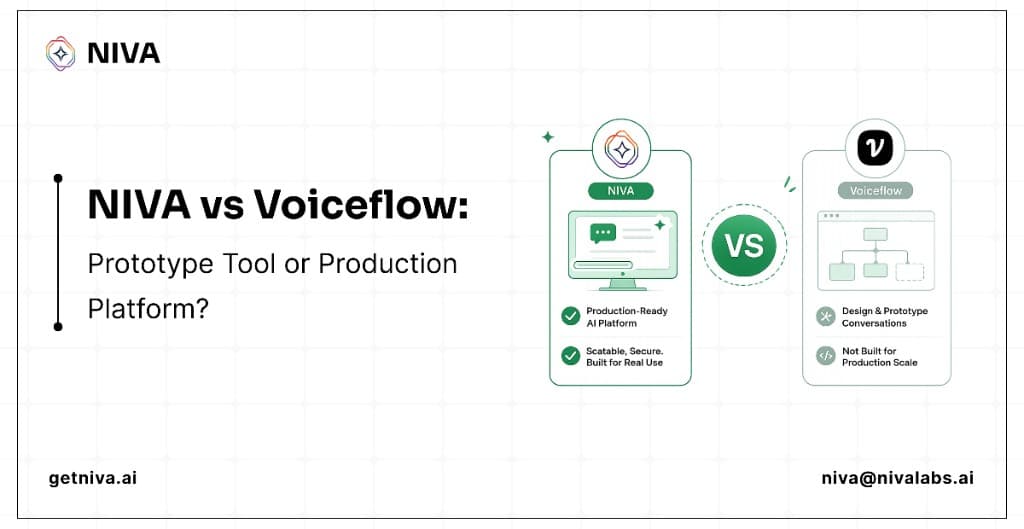
Is Voiceflow a prototype tool or a ready platform? Neither label is fair, and the framing is a little unkind to a product people clearly like.
The honest answer is that Voiceflow is a builder's platform, and it is a good one. It assumes you want to build, that you have someone to do it, and that you will keep doing it. Priced per editor and metered by credits, it fits an agency or an in-house team whose job is making agents.
NIVA assumes something different. That you have a business to run, that a chatbot is a means and not the project, and that you would rather start from something that already knows your industry than from a beautiful empty screen.
Both are valid. They are just answers to different questions, and the mistake is not picking the wrong one. It is not noticing which question you were asking.
So before the demo, work out which room you are in. If your team's job is building conversational agents, buy a canvas. If your team's job is selling rooms, closing loans, onboarding users, or answering customers, buy something that already arrived ready.
Not sure which room you are in? Spend twenty minutes with NIVA and see how far a ready-made industry persona gets you before you have built a single flow. Prefer to talk it over first? Get in touch. And if pricing predictability is the thing bothering you, what AI chatbots really cost in 2026 is the plain version.
Sources
Voiceflow pricing page, checked August 2026, which lists no public plan prices; G2 rating and user reviews for Voiceflow; third-party pricing trackers for previously published Voiceflow plan figures.
Frequently asked questions
Is Voiceflow a prototype tool or a production platform?
Neither label is fully fair. Voiceflow is a strong builder's platform for teams and agencies that want granular canvas control. Its free tier is documented as not suitable for production, and the commercial model (editors + credits) is shaped around builders, not business teams launching this month.
How does Voiceflow pricing compare to NIVA?
Voiceflow no longer publishes plan prices publicly and sells through demos. Historical third-party figures cite editor seats and metered credits. NIVA uses published, plan-based pricing without per-editor seat maths or silent agents when credits run out.
When should I choose Voiceflow over NIVA?
Choose Voiceflow if you are an agency or builder whose job is designing bespoke agents turn by turn and you want maximum canvas control. Choose NIVA if you need an industry-aware assistant in production this month with predictable cost.
Does NIVA have a visual builder like Voiceflow?
Yes. NIVA's Flow Engine is a no-code visual builder for multi-step journeys, forms, and API webhooks. The difference is that you start from 250+ industry personas instead of a blank canvas.
What is the closest Voiceflow alternative on NIVA's comparison pages?
Botpress is the closest in shape and philosophy among NIVA's alternatives. See the full alternatives library for Botpress, Chatbase, Tidio, and more.
See how far a ready persona gets you
Book a 20-minute demo and start from an industry persona before you build a single flow. Or talk it through with us first.